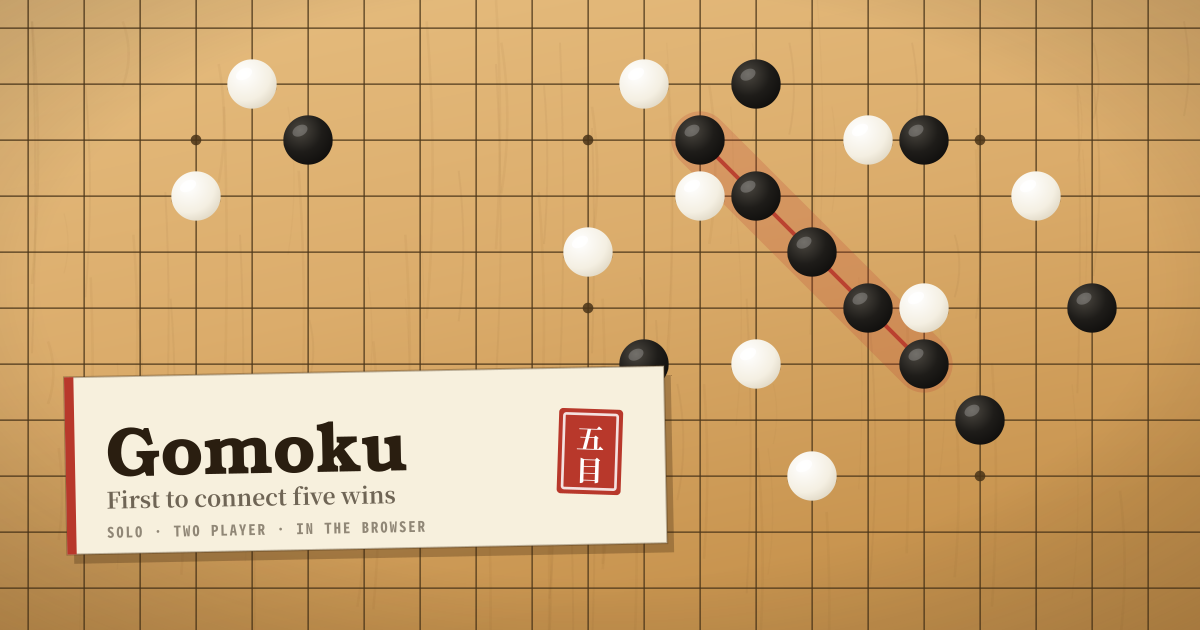
How Omok is played: board, turns, and five in a row
Omok is a two-player game of pure alignment played on the intersections of a grid. The standard board is 15×15, the size used in tournament Renju and in most apps. Casual players sometimes borrow a 19×19 Go board; the game works the same way, but the extra room makes defence slower and games longer. Stones go on the crossings of the lines, not inside the squares, and once placed they never move and are never captured.
Black plays first and the players alternate one stone at a time. The first player to make an unbroken line of five stones of their own colour — horizontally, vertically or along either diagonal — wins immediately. If the board fills up with no five, the game is a draw, though on a 15×15 board that almost never happens.
The first move matters more than it looks. In free-style play, where both sides follow exactly the same rules, Black is always one stone ahead. Every time White answers a threat, Black adds the next stone and starts a new one; White is forever responding. Analysis has shown that with correct play Black can force a win from the opening, which is why serious competition adds restrictions on Black. On a casual board the advantage is simply something to know: swap colours between games, and do not be surprised when the player with Black wins more often.
Renju restrictions on Black, explained plainly
Renju is the tournament form of the game. Its rules keep the goal — five in a row — but forbid Black from using the strongest shapes. Under Renju rules Black may not play a double three, a double four or an overline; doing so loses the game on the spot. White is free to play all three, and for White an overline counts as a win.
The restrictions exist because each of those shapes is an unstoppable double threat: the opponent can block only one line per turn. Black already has the tempo advantage, and giving Black these shortcuts as well makes the game a forced win for the first player. Taking them away from Black and leaving them to White is roughly what it takes to balance the game. Many casual apps, including the board on this page, skip the restrictions and play free-style, so check which rules are in force before you argue about a 3-3.
To follow the rules you need a small vocabulary:
- Three: a line of three stones that could become an open four in one move. An open three has empty points at both ends (and beyond them), so it can grow into a four on either side; a closed three is blocked on one end.
- Four: four stones needing one more to make five. An open four has both ends free and cannot be stopped; a closed four has one free end and must be blocked at once.
- Double three (3-3): a single stone that creates two open threes at the same time.
- Double four (4-4): a single stone that creates two fours at the same time, on two different lines or even on one line with a gap.
- Overline: six or more stones in an unbroken row.
The shapes that decide games: threes, fours, and the four-three
Almost every game turns on a handful of shapes. Learn to see them and you will stop losing to surprises.
- Open three (both ends free): a threat with a delay. Left alone it becomes an open four next move and the game is over. It must be answered now, but the defender still gets to choose which end to block.
- Closed three (one end blocked): not yet a threat. It can only grow into a closed four, which is blockable. Ignore it unless it is part of a larger plan.
- Closed four (one end free): a forcing move. The opponent must block the single open end this turn or lose. Fours are how you gain tempo — the opponent has no choice.
- Open four (both ends free): a win. Two ends, one block per turn. Whoever creates one wins next move.
- Four-three: the standard winning pattern. One stone makes a closed four and an open three at once. The opponent must answer the four; the open three then becomes an open four and there is no defence. Most decisive games end with a four-three, not with a spectacular five.
- How to defend: mostly a question of which end to block. Against an open three, blocking either end reduces it to a closed three, but the two ends are rarely equal: choose the end where your blocking stone also extends one of your own lines, or takes a point the opponent wanted for a second shape. Against a closed four there is no choice — take the last point.
- Before you block, glance along the line you are about to close: if the point two steps away is empty, a “broken three” with a gap (X X _ X) counts as a three too and needs the same attention.
Beginner mistakes and a three-step check before each move
The same handful of errors lose most beginner games. They are listed below; the check that follows catches most of them.
A simple check before each move takes a few seconds and catches most of these. (1) Look at the opponent’s last stone and ask whether it made a four or an open three in any of the four directions — if yes, you must block. (2) If not, ask whether you can make a four-three, or a four that leads to one. (3) If neither, place the stone that adds to two of your lines at once, since the crossings of your own lines are where future four-threes come from.
- Reacting to every stone. A closed three is not a threat. If you answer it you have given away a move for nothing. Only open threes and fours demand a reply.
- Blocking the wrong end. Both ends stop an open three; usually only one of them helps you. Pick the end that also builds your line, or that sits where the opponent’s next shape would need to go.
- Ignoring diagonals. Horizontal and vertical lines are easy to see; diagonals are where most “how did I not see that” losses come from. Scan all four directions from the opponent’s last stone.
- Building your own threat while the opponent already has one. A closed four on the board beats your open three every time, because it forces a reply first. Count the opponent’s threats before you count yours.
- Playing on the edge. A stone near the edge has fewer lines through it, and the edge blocks one end of every line for free. Fight in the middle first.
Playing on this board
Try Dabble Omok is a free-style board in the browser: 15×15, Black first, five or more in a row wins, no Renju restrictions. There is nothing to install; open the page and you are Black.
- Choose AI or two-player on the start screen. The AI has three levels: easy sometimes misses an open three, hard almost always blocks an open four, so wins against it come from four-threes.
- Two-player is hot-seat on one device — pass the tablet across or take turns tapping.
- Undo takes back the last move; against the AI it takes back your move and the reply together.
- After the game the board stays on screen, so you can walk back through how the winning line came together.
- Stones sit on intersections. On a phone, zoom a little and tap the crossing, not the square.
What the game keeps on your device
Nothing about a game leaves your device. The board, the move history and the AI’s replies exist only in the open tab, so closing it or refreshing the page ends that game. The one thing the game remembers between visits is the language you chose.
Is 3-3 forbidden for both players?
No. Under Renju rules only Black is banned from double threes, double fours and overlines. White may play all of them; that is how the first-move advantage is offset. In free-style play, which this board uses, nobody is restricted: either side may play a 3-3, and five or more in a row wins.
Does six in a row count as a win?
It depends on the rules. In free-style play, including this board, five or more wins, so six counts. In Renju, six or more is an overline: a loss for Black and a win for White. Some Gomoku variants demand “exactly five”, in which case an overline means nothing for either side and the game simply continues.
What is the difference between Omok, Gomoku and Renju?
Omok is the Korean name, Gomoku (五目並べ) the Japanese name and Wuziqi (五子棋) the Chinese name for the same game. Played free-style, there is no difference between them. Renju is the tournament form: it adds the double-three, double-four and overline bans on Black, plus opening rules that fix the first few moves or let players swap colours. When a casual app says “Omok” or “Gomoku” it usually means free-style.