How an exchange rate is quoted
The rate you see on a news site or in a search box is the mid-market rate: the midpoint between what large banks are paying for a currency and what they are selling it for at that moment. Nobody changing money on a street corner gets that number. A bank, a booth or a card network quotes two prices instead. The buy rate is what they pay you for your currency, the sell rate is what they charge you for theirs, and the two sit on either side of the mid-market rate. The gap between them is the spread, and the spread is where the money is made.
That is why a booth advertising “0% commission” or “no fees” is not lying, but is not cheap either. It has simply moved its fee into the rate. Suppose the mid-market rate is 1 USD = 150 JPY. A booth with a big “no commission” sign sells yen at 138 per dollar. The bank across the road sells at 147 and charges a 3 USD flat fee. Change 300 USD at the booth and you walk away with 41,400 JPY. At the bank, 297 USD at 147 gives 43,659 JPY. The “free” booth cost you roughly 2,260 JPY more, about 5% of your money, and nothing on its sign was false.
The only number that lets you compare two offers is the amount of local currency you actually end up with for a fixed sum of yours, after every fee, measured against what the mid-market rate would have given you. That difference, expressed as a percentage, is the real price of the exchange, whether it is labelled a commission, a service fee or nothing at all.
- Look up the mid-market rate once before you compare anything; a converter that shows the reference rate is enough.
- Ask “how much will I get for 300 dollars, all in?” rather than “what is your rate?”. The rate alone hides flat fees.
- Treat “0% commission” as “the fee is inside the rate”. Check the sell rate against the mid-market rate.
- A narrow spread plus a flat fee wins for larger amounts; a wider spread with no flat fee can win for very small ones.
The usual options, ranked by typical cost
Fees vary by bank, by card and by country, so treat the numbers below as typical ranges rather than a price list. To keep it concrete, imagine converting 1,000 USD worth of money into yen when the mid-market rate is 1 USD = 150 JPY, so the reference amount is 150,000 JPY. The options are listed from cheapest to most expensive.
Between the best and the worst option the gap on 1,000 USD is roughly 15,000 JPY, the price of a good dinner for two. The practical pattern that follows: pre-order a small amount of cash for the first day, pay by card for most things, and make one larger ATM withdrawal when cash runs low. Use the airport or hotel only for the amount you need in the next hour.
- Card payment with a card that has no foreign transaction fee: the network applies a rate close to mid-market, usually within 1%. You keep roughly 148,500 to 150,000 JPY of value. This is the cheapest option in practice, but only if you refuse the terminal’s offer to convert (see the next section). A card that charges a 3% foreign fee drops you to about 145,500.
- Bank or online pre-order, collected at a branch or delivered: a spread of roughly 1 to 2%, sometimes with a small flat fee. About 147,000 to 148,500 JPY. The best way to get cash for arrival.
- ATM abroad with a debit card: the network markup of about 1%, your home bank’s foreign fee of 0 to 3% plus a flat 2 to 5 USD, and the local operator’s fee of 0 to 5 USD. Typically 2 to 5% all in, so about 142,500 to 147,000 JPY. One larger withdrawal beats several small ones because the flat fees are charged each time.
- Airport kiosk: a spread of 5 to 10%, often plus a flat fee. About 135,000 to 142,500 JPY. That is 6,000 to 12,000 JPY less than a bank pre-order on the same 1,000 USD, a gap of roughly 4 to 8%.
- Hotel front desk: usually the widest spread of all, 8 to 12%, charged for the convenience. About 132,000 to 138,000 JPY.
Dynamic currency conversion: always choose the local currency
At some point a card terminal or an ATM will ask whether you would like to pay in your home currency instead of the local one, often with a reassuring line about knowing the exact amount. This is dynamic currency conversion. The conversion is then done by the merchant’s payment provider or the ATM operator, at a rate they choose, and that rate is typically 3 to 7% worse than the one your card network would have applied. Your own bank may still add its foreign transaction fee on top, because the merchant is abroad regardless of the currency shown.
A short example. The bill is 10,000 JPY and the mid-market rate is 150. Choose JPY, and the card network converts at close to 150, so about 66.67 USD lands on your statement, plus whatever foreign fee your card carries, at most a couple of dollars. Choose USD on the terminal, and it converts at something like 142, so 70.42 USD, and the foreign fee may still apply. You have paid 3 to 4 USD more for a 10,000 JPY meal, around 5%, in exchange for seeing a dollar figure a few seconds earlier.
- Watch for wording such as “pay in USD?”, “guaranteed rate”, “with conversion” or a pre-selected home currency. Choose the local currency or “without conversion”.
- At ATMs the prompt may be phrased as accepting or declining a conversion. Decline it; the withdrawal still goes through.
- If a cashier taps through the screen for you and the receipt shows your home currency, ask for the transaction to be voided and rerun.
- Keep the receipt until the statement arrives; the currency on the receipt is the currency you were charged in.
How stale can an offline rate be before it matters?
Major currency pairs move less than 1% on a typical day, and even an eventful week rarely moves more than 2 to 3%. A rate synced yesterday is therefore a rounding error for a menu, a train ticket or a bottle of water: 1% of a 1,500 JPY lunch is 15 JPY. Any spread you pay at a booth is several times larger than that drift, which is why a day-old reference rate is still the right yardstick for judging a booth.
Age starts to matter in two situations. The first is a large purchase, such as a camera, a hotel bill settled in cash or a decision about whether a refund is worth queuing for, where 1% is real money and you want today’s rate. The second is a volatile week, around a central bank decision or an election, when a move of 3 to 5% in a few days is possible. In both cases, re-sync, and then compare all-in amounts rather than the reference rate alone.
- Sync whenever you are on hotel Wi-Fi anyway, typically once each morning; it costs nothing.
- A rate under three days old is fine for anything up to about 200 USD worth.
- Re-sync before any single purchase over about 500 USD worth, or if the rate is more than a week old.
- Reference rates are published once per business day, so a sync on a Sunday shows Friday’s rate. That is normal, not an error.
- If a converted amount looks surprising, re-sync before trusting it.
Converting on the plane with Fxpad
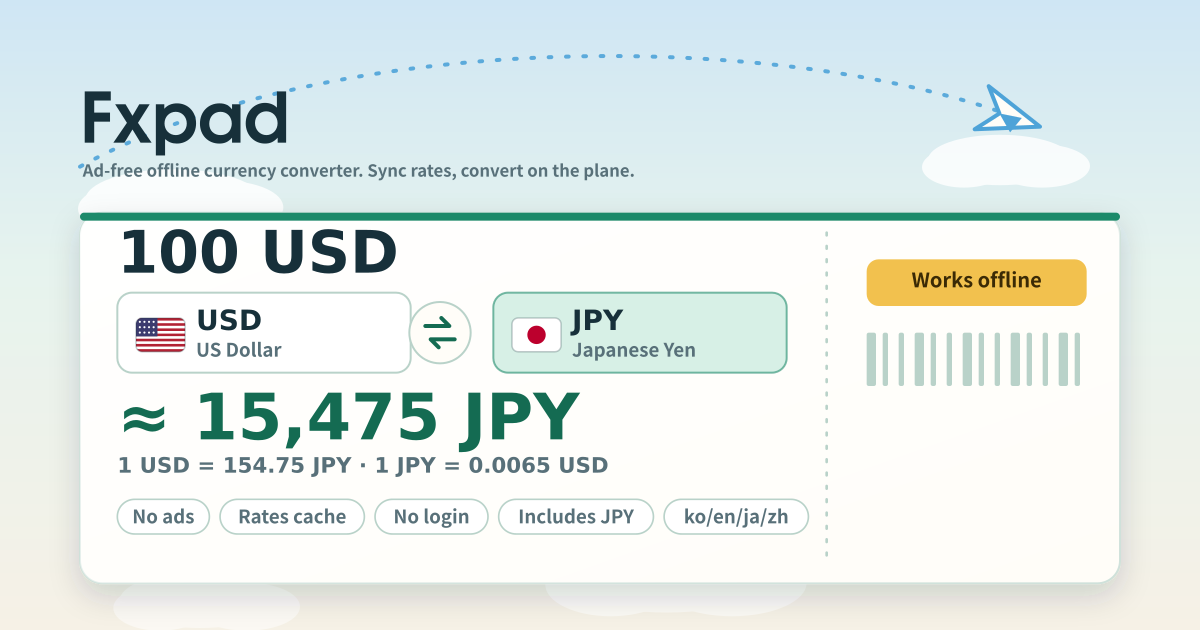
Fxpad is the small tool this guide sits beside. It keeps a table of daily reference rates on your phone, so every comparison above can be done from an aisle seat with the modem off, and any rate a booth quotes can be turned into a percentage against the reference in a few seconds.
- Sync once: open it on Wi-Fi before you leave. It pulls the day’s reference rates on open, and “Refresh rates” fetches them again on demand.
- Then it works offline: in airplane mode or without roaming, the status line reads “Using cached rates” and shows the date they are for.
- Type an amount and pick two currencies from a searchable list with flags; the round button swaps them. The result shows the one-unit rate in both directions, such as “1 JPY = 0.0067 USD”.
- Around 30 currencies are covered, including JPY, KRW, USD, EUR, CNY, HKD, SGD and THB. Your last amount and pair are still there next time.
- No ads, no login, no paid tier, and an A / A+ / A++ switch for reading at arm’s length.
What Fxpad stores and where
The rate table, your last amount, the currency pair and the text size are kept in the browser on your own device, and nothing else is kept anywhere. Fetching rates sends a plain request for the day’s table and carries no amount or currency choice. There is no account, no sync between devices and nothing to delete on a server.
Should I pay in local currency or my home currency?
The local currency, every time, on both card terminals and ATMs. When you choose your home currency the merchant’s provider sets the rate, typically 3 to 7% worse than your card network’s, and your bank’s foreign fee usually applies anyway. Choosing the local currency lets the network convert at close to the mid-market rate. The only thing you give up is seeing a home-currency figure a few seconds earlier.
Is the airport really that much worse?
Usually, yes. Airport kiosks pay high rent to serve a captive audience and price accordingly, with spreads of 5 to 10% against 1 to 2% for a bank pre-order. On 1,000 USD that is a gap of several thousand yen. Fees vary by operator, and a few airports have competitive counters, so compare the all-in amount against the reference rate before you hand anything over. Changing only what you need for the first few hours limits the damage.
How old can the rate be?
For everyday spending, a few days is fine: daily moves are usually under 1%, far smaller than any exchange spread. Re-sync before a purchase over roughly 500 USD worth, when the rate is more than a week old, or during a week of unusual news. Reference rates are published once per business day, so a weekend sync showing Friday’s date is expected.