Cool it fast: the two-hour rule
The moment a dish comes off the heat, a clock starts. The bacteria that cause food poisoning multiply fastest between roughly 5 °C and 60 °C (40–140 °F), the range food-safety agencies call the danger zone. Most guidance says cooked food should be in the fridge within about two hours of cooking, and within one hour if the kitchen or the weather is hot, above about 32 °C (90 °F). The common habit of letting a pot cool on the stove overnight is the single biggest risk in most home kitchens.
The trap is a big pot. A litre of soup in a deep pan can stay warm in the middle for hours after the surface feels cool, and a fridge cannot pull heat out of the centre quickly. Split it into shallow containers no deeper than about 5 cm (2 inches), leave the lids loose until it stops steaming, or stand the pot in a sink of cold water and stir. Once it is lukewarm, cover and refrigerate. You do not need to wait until it is fully cold; a modern fridge copes with warm food in small batches.
The same logic applies to rice, which is often left sitting in the cooker. Cooked rice and other starches can carry spores that survive cooking and grow when the rice sits warm. Get it into the fridge quickly rather than leaving it on the counter for tomorrow.
How long cooked food keeps, by category
The ranges below are widely published general food-safety guidance, not medical advice, and they assume the food was cooled quickly and stored at or below 4 °C (40 °F) in the fridge and −18 °C (0 °F) in the freezer. Ranges vary by country; if your local food-safety authority says something different, follow it. One more thing: quality usually drops before safety does. Frozen food stays safe far longer than the months listed, but texture and flavour fade.
Printed dates on packaging are for the unopened product. Once you open or cook something, the countdown starts again from that moment, and the shorter of the two dates wins.
- Cooked rice, pasta and grains: 3–4 days in the fridge; 1–2 months frozen. Rice is best eaten within a day or two.
- Cooked meat and poultry (roasts, stir-fries, cutlets): 3–4 days in the fridge; 2–6 months frozen depending on how well it is wrapped.
- Soups, stews and curries: 3–4 days in the fridge; 2–3 months frozen. Cream- or potato-based soups freeze less well.
- Cooked fish and seafood: 2–3 days in the fridge; 2–3 months frozen. Fish spoils faster than meat, so err on the short side.
- Cooked vegetables: 3–4 days in the fridge; 8–12 months frozen, though they go soft after thawing.
- Cut fruit and salad: 3–5 days in the fridge, often less for melon and berries; freezing works for smoothies, not for eating fresh.
- Opened dairy (milk, yoghurt, soft cheese): milk about 5–7 days after opening, yoghurt up to its printed date if it stays cold; most dairy does not freeze well.
- Cooked eggs and egg dishes: 3–4 days in the fridge; they do not freeze well.
Signs food has turned, and what your nose cannot tell you
Sour or sharp smells, slimy or sticky surfaces, cloudy liquid, fuzzy spots, a lid that has puffed up, or a colour that has shifted to grey or green are all reasons to throw food out. So is a fizzy taste in something that should not be fizzy. Mould on soft foods such as stew, rice, cut fruit, soft cheese and bread means the whole item goes; the visible spots are only the surface of a network that has spread deeper.
But smell and appearance only catch spoilage organisms, the ones that make food unpleasant. The bacteria that actually make people ill, such as Salmonella, Listeria and the toxin-forming spores in rice, do not smell, do not change colour and do not taste different. Food can look and smell perfectly fine and still cause illness if it sat warm too long or has been in the fridge for a week. That is why the day count matters more than the sniff test.
The rule that survives every argument: when in doubt, throw it out. A portion of leftovers is cheap; a night of food poisoning is not. If you cannot remember when something was cooked, treat that as your answer.
Label, rotate, freeze in portions, reheat once
Most leftover waste is not from spoiled food; it is from food nobody could identify. Write the dish and the date on the lid with a marker or a strip of masking tape. If you cook the same things often, the date alone is enough.
A freezer is a pause button, not a reset. The days a dish spent in the fridge before freezing still count once it thaws, so freeze early, on day one or two, rather than on the last safe day.
- Front of the shelf: put new containers behind older ones so the oldest is what you reach first. Restaurants call this first in, first out.
- Freeze in single portions. A flat bag of curry freezes and thaws in a fraction of the time a brick does, and you take out only what you will eat.
- Thaw in the fridge, not on the counter. Overnight in the fridge is the safe default; a sealed bag in cold water or the microwave defrost setting works if you cook it straight away.
- Reheat until steaming hot all the way through, about 75 °C (165 °F) in the middle. Stir soups and microwaved dishes halfway to remove cold spots.
- Reheat once. Take out only what you will eat, and do not return warmed food to the fridge for a second round.
- Do not refreeze food that has thawed unless you cooked it in between. Raw meat you thawed and then cooked can be frozen again as a cooked dish.
Tracking containers with Leftover Box
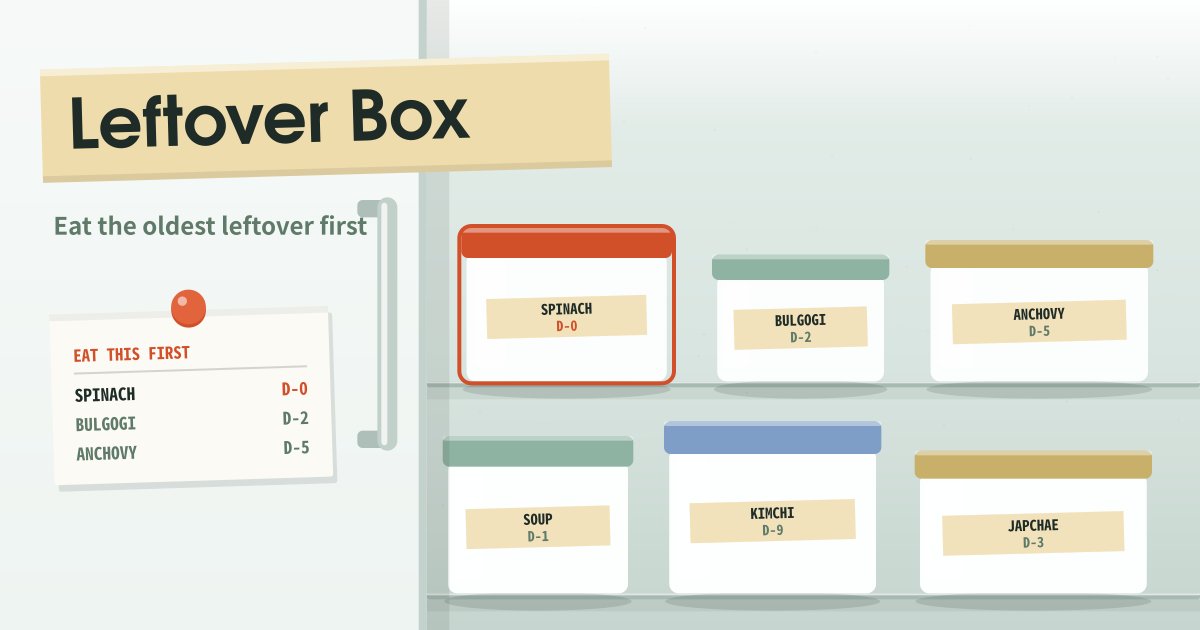
The hard part of all this is not the rules; it is remembering what is in the fridge and when it went in. Leftover Box is a small list for exactly that. Write a dish name, the day you cooked it and the day it should be eaten by, and the list sorts whatever is due soonest to the top.
- Dish name is required; cooked-on defaults to today and eat-by defaults to cooked-on plus three days, which you can change to match the ranges above.
- Optional location (fridge, freezer, other) and a one-line note, such as ‘double portion’ or ‘for Thursday lunch’.
- Badges show D-2, today or overdue at a glance, so you can pick lunch without opening every container.
- Mark an item eaten to keep a short history; edit or delete anything.
- Export and import JSON to move the list to another phone.
Where the list lives
Everything you type stays on the device you typed it on. There is no account, no sync and no server copy, so export the JSON before you switch phones. On a shared device, clear the site data when you are done.
Is cooked rice really risky after a day?
Rice is the leftover most guidance singles out. Bacillus cereus spores survive cooking and, if rice sits warm, they grow and produce a toxin that reheating does not destroy. Rice that was cooled quickly and refrigerated is generally fine for a day or so, and many authorities allow up to 3–4 days if it went into the fridge within an hour or two. The risk is in the warm rice cooker or the pan left on the counter, not in the fridge. When you reheat it, make it steaming hot, and do it once.
Can I freeze food that was already in the fridge for three days?
Yes, if it is still safe to eat, because freezing stops bacterial growth. But it does not undo the three days. Once thawed, treat it as having a day or so left rather than a fresh 3–4 days, and eat it straight after reheating. Quality also suffers. The better habit is to freeze the surplus on the day you cook it and keep only the next two days’ worth in the fridge.
Does reheating reset the clock?
No. Reheating kills most live bacteria, but it does not remove the toxins some of them have already produced, and it does not change the age of the food. A stew reheated on day four is still a four-day-old stew. Reheat only the portion you are going to eat, make it steaming hot throughout, and throw away what is left rather than cooling it again.