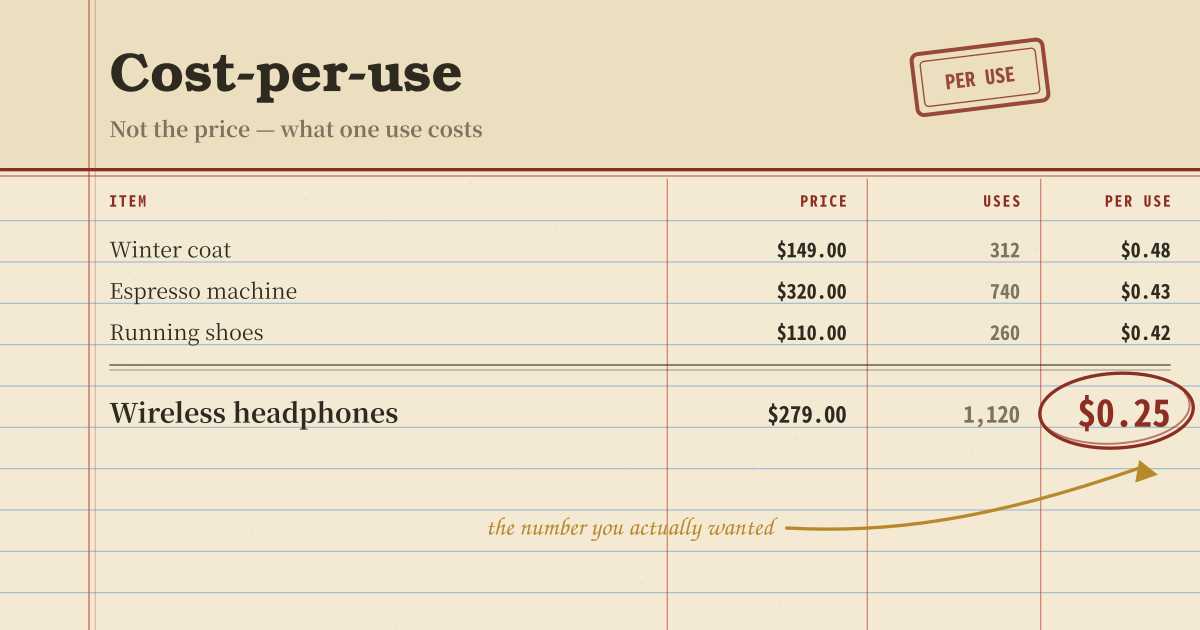
The formula: price divided by the uses you will actually get
Cost per use is the simplest way to compare two things that do the same job but cost different amounts. Instead of asking “which one is cheaper?”, you ask “which one is cheaper each time I use it?”. The arithmetic is one division, and the genuinely useful trick is turning it around into a break-even count.
- Cost per use = price ÷ expected number of uses. A 120 jacket worn 60 times costs 2 per wear; the same jacket worn 6 times costs 20 per wear.
- Cost per day is the same idea with time as the divisor: price ÷ the days you expect to own and use it. It suits things you use continuously, like a mattress or a phone.
- Break-even uses = price difference ÷ per-use saving. If the expensive option saves you a fixed amount each time (a café coffee you no longer buy, a rental fee you no longer pay), this tells you how many uses it takes to pay back the extra price.
- Break-even for durability: when the cheaper item wears out and has to be bought again, compare price ÷ lifespan-in-uses for each. The expensive one wins once its lifespan is longer than the price ratio.
Three worked examples
The currency does not matter; the ratios do. All three examples use round figures so you can redo them with your own prices. The formula is exact, but the input called “expected uses” is a guess. Most of the mistakes people make with cost per use are guesses that were too optimistic, which is why the examples below use deliberately modest numbers.
- Shoes, 200 vs 60, over two years. Say the 60 pair lasts about 8 months of regular wear and the 200 pair lasts the full two years. Over two years you buy three cheap pairs (180) or one good pair (200). At roughly 3 wears a week, two years is about 300 wears: the cheap route costs 0.60 per wear, the good pair 0.67. Nearly a tie; the good pair only wins if it lasts beyond two years, or if you value not shopping for shoes three times. If you would only wear them once a week (about 100 wears), the good pair costs 2.00 per wear, while one cheap pair would still be alive at 0.60. Buy the cheap one.
- Espresso machine vs café coffee. A 600 machine plus 0.40 of beans and milk per cup, against 4.00 per café coffee. Per-use saving = 4.00 − 0.40 = 3.60. Break-even uses = 600 ÷ 3.60 ≈ 167 cups. At one cup every weekday that is about eight months; at two cups a week it is a year and a half. If you keep going to the café for the sitting-down part, the saving shrinks to only the cups you actually replace.
- Gym membership vs pay-per-visit. A 50-a-month membership against 12 per single visit: break-even = 50 ÷ 12 ≈ 4.2 visits a month. Go five or more times a month and the membership is cheaper; four or fewer and pay-per-visit wins, and you keep the freedom to stop without cancelling anything. Count last month’s real visits, not the ones you intended.
Where the rule misleads
Cost per use squeezes a purchase into one number, and that number hides five things.
- Resale value. What you can sell it for at the end comes off the price. A 1,000 camera that resells for 500 after 200 outings cost 2.50 per outing, not 5.00. The cheaper item usually resells for little or nothing, so ignoring resale flatters it.
- Maintenance and consumables. Beans, filters, descaler, replacement pads and the electricity a machine draws are per-use costs that belong in the formula, and so does the annual service the cheap item never needs. Add them to the per-use figure before comparing.
- Usage you overestimate. The number of times you will use something is the number you control least. Someone who bought exercise equipment “for daily use” and used it twelve times has a cost per use a hundred times what they calculated. Use last year’s behaviour as the forecast, not next year’s intentions.
- Items where quality changes the outcome. If the better tool produces a better result (a knife that actually cuts, a mattress you sleep on every night), cost per use undercounts it, because the two options are not delivering the same thing per use. The reverse holds too: a premium version of something you use badly is the same result at a higher price.
- Subscriptions that renew. A subscription’s price is not what you paid once but what you keep paying, so its cost per use is monthly fee ÷ uses that month, recalculated every month. A membership you use twice in January is 25 a visit that month regardless of what December looked like.
Thresholds you can actually use
Precise break-even counts are worth doing once per big purchase. For everyday decisions, a few rules of thumb cover most cases.
- Buy the better one when you will use it more than about eight to ten times a month. At that rate almost any durable item beats its consumable or rental equivalent within a year, and the difference in comfort or result is something you feel every week.
- Rent, borrow or pay per use below roughly ten uses a year. A drill, a suit, a ski set or a carpet cleaner used a few times a year rarely pays for itself, and the space it takes up is a cost too.
- In between, run the break-even number and then halve your expected uses. If the purchase still wins with half the usage, buy it. If it only wins at your optimistic estimate, it usually will not win at all.
- Treat a subscription as a monthly decision: if last month’s uses times the pay-per-use price came to less than the fee, cancel and pay as you go until it does not.
- Prefer the cheaper option when you are not sure you will keep the habit. Cost per use punishes abandoned purchases far more than it rewards good ones.
Working it out in the calculator
The cost-per-use calculator on this site does the division for you and keeps a list, so you can compare several candidates side by side or audit what you already own.
- Enter the item name, purchase price and purchase date.
- Set the expected lifespan in days, months or years; cost per day = price ÷ that span. If lifespan is empty the app divides by days since purchase, so an item bought today shows close to full price until you fill it in.
- Add times used (optional) to get cost per use = price ÷ count.
- For a break-even comparison, add both candidates as separate rows with the same expected uses and read the difference.
- Update the use count occasionally; the honest number a year later is the one that matters.
Where your entries stay
Items you add are kept in this browser on this device, with no account and no copy elsewhere. Add it to your home screen as a PWA and the list stays available offline. On a shared computer, clear the site data when you are done.
Is cost per use the same as cost per wear?
Yes. Cost per wear is the same division applied to clothing; wardrobe writers use the term because clothes are bought on impulse and worn rarely. The break-even logic is identical: an expensive coat beats a cheap one only if it is worn at least as many more times as the price ratio.
Should I count resale value?
Yes, if you will actually sell it. Subtract the expected resale price from the purchase price before dividing. Be conservative: use the price similar used items sell for right now, not the new price minus a bit. If you will not sell it, or will not get around to it, leaving resale at zero is the honest choice.
How many uses should I assume?
Count what you actually did over the last year with a similar item, not what you plan to do. If you have no history, assume half of what feels reasonable and recompute after three months with the real number. If the purchase still wins at half, the decision is safe.