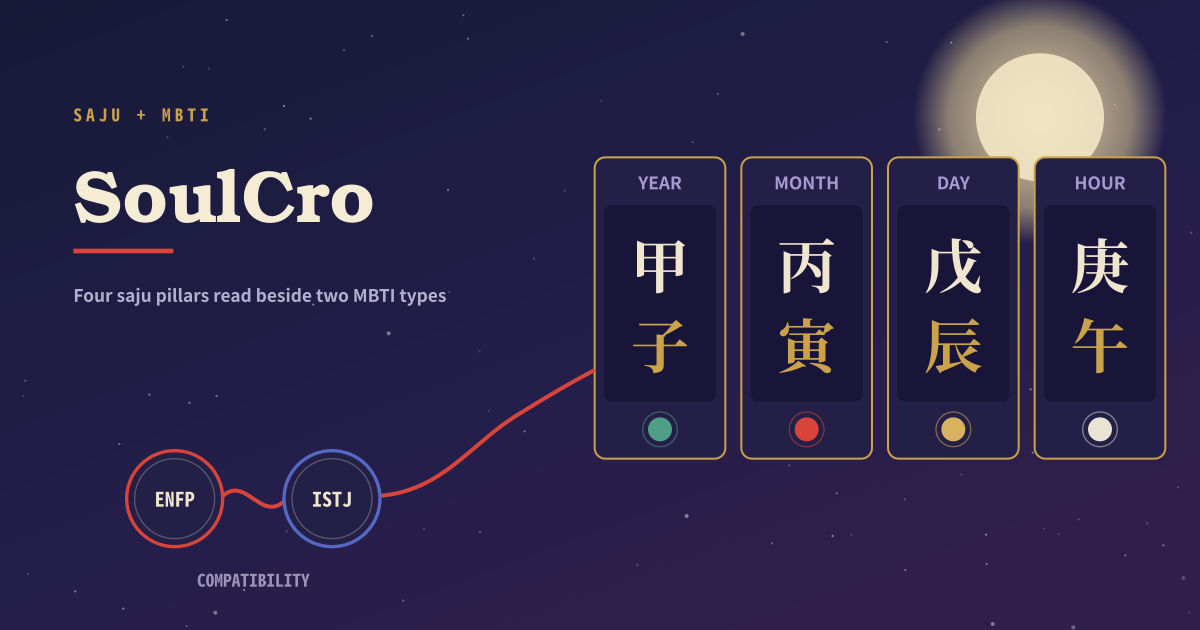
A Saju chart and an MBTI type on one screen
Chaldduk puts a Saju chart from birth date and time next to an MBTI type. The Saju side scores relationships that show up often in Four Pillars work — day master, ten gods, combinations and clashes. The MBTI side adds how each of the 16 types tends to talk and where friction usually sits. It does not collapse two people into one yes-or-no line. It splits where they tend to fit and where they tend to miss.
Daily fortune and the time-of-day (sijin) notes use the same day master. Change the date and the copy changes. It runs in the browser with no account.
- Birth date and time. If the hour is unknown, the hour pillar is left empty and the day, month, and year do more of the work.
- Four-letter MBTI. If you do not know yours, a short in-app quiz can pick an approximate type. It is not a certified inventory.
- Compatibility needs two people. Daily fortune works with one.
What Saju and MBTI are, and what they are not
Saju, the Four Pillars, is a traditional East Asian system that writes the year, month, day, and hour of birth as four pairs of heavenly stems and earthly branches, then reads the relationships between those pillars. The day stem stands for the person, the other characters are named as ten gods, and combinations and clashes become the raw material for interpretation. It has a long written tradition, but no controlled study has shown that its readings predict how a life actually goes.
MBTI is a self-report personality questionnaire. It sorts answers along four axes (E/I, S/N, T/F, J/P) into one of 16 types, and the result can shift with mood and how a person happens to answer that day. It is a handy vocabulary for talking about temperament, but there is no established evidence that it predicts life outcomes such as job performance or whether a relationship lasts.
Chaldduk combines the two for entertainment and as something to talk about. Read the result for fun, and use it to open a conversation with a friend or partner. Decisions about health, money, marriage or breakups, contracts or legal matters should not rest on a score or a sentence from this screen. Make them with people you trust and with professionals in that field.
How the readings are generated
Everything is computed in the browser. The birth date and time you enter are converted to stems and branches to fix the day master and the ten gods; the tool then counts how many combinations and clashes overlap between two people’s pillars and whether the ten gods generate or control each other. The MBTI letters are compared axis by axis. The score and the copy are assembled from those results by a fixed set of rules and text templates, and the daily fortune matches the same day master against the date and the time slot to pick its wording.
The only inputs that change a reading are the birth date and time, the four MBTI letters, and the date you typed. No name, location, visit history, or other people’s results are used, and the same values produce the same text for anyone. So if a line feels unusually accurate, that is because short readings are written to fit many people, not because the screen knows you.
How to read the score
The score mixes how the ten gods generate or control each other with how many stem/branch combinations and clashes sit in the two charts. A high number is not “no conflict.” More combinations usually mean it is easier to stick; more clashes usually mean shorter conversations. Matching MBTI letters (E/I, S/N, T/F, J/P) tends to make the tone easy; opposite letters change the temperature even when the Saju looks friendly.
Keep it as play
Saju work usually sits on a full natal chart plus luck cycles. MBTI is one personality model. This page overlays the two to write a short note. Do not hand marriage, jobs, or health to the score. If the birth hour is unsure, leaving it blank is better than guessing.
A fortune before work, a match before a first date
Most visits are a glance at today’s fortune before leaving the house. The day master is already stored, so the copy changes when the date does. The time-of-day note is a temperature check for the next couple of hours. Do not move a meeting because of it. Treat it as a one-line mood for the day.
People also punch in two profiles before a first meeting. A high score is not a green light. The weaker axes show where a talk tends to stall. A T/F split changes the temperature of advice; a clash in the pillars often means shorter sentences. Most readers use it only to pick a safer topic.
Some people know their MBTI and have never seen a Saju chart. They check the day master and leave. If the hanja gets in the way, read the score and the type’s tone and skip the ten-god names. Readers who already know Four Pillars often look only at combinations and clashes. The page still works if one side is empty-ish.
Is this a professional reading?
No. It overlays a day master, ten gods, combinations, and four MBTI letters into a short note. It is not a natal-chart reading, it does not walk luck cycles, and it does not keep a history. Read it as play. Make the real call with people, not with the score.
What if I do not know the birth hour?
Leave the hour pillar blank. Guessing a time is worse. Some charts flip the ten gods when the hour changes. Date alone is enough for the broad daily note and the main compatibility axes. Add the hour later if you find it.
Is there adult content in the compatibility copy?
No. Compatibility copy stays on conversation and the temperature of a relationship. There is no adult-only track, and the wording is kept at a level you can read together with friends or family.