What makes a jump feel fair
A platformer is fair when the player can blame themselves. That sounds harsh, but it is the whole design. Every death has to be readable: the spike was visible before the jump, the gap was measurable, and the jump arc was the same one you used a moment ago. When those three hold, a fall is information. When any of them slips, the game feels like it cheated.
Consistency is the first rule. A jump that always goes the same height and distance lets you learn it once and trust it forever; a jump whose height varies with how long you held the button adds range at the cost of precision. Neither is wrong, but a game has to pick one and keep it.
Hazards should be telegraphed slightly before they punish. A ledge that vanishes on contact is fair if the same kind of ledge has already vanished under you once, in a place where the fall was cheap. A spike placed exactly where a recovery lands you is not.
The last piece is the cost of failure. Restarting from zero teaches caution; sliding down one layer and climbing again teaches routes. Difficulty then comes from spacing the blocks wider, not from hiding more traps.
Four layers from underground to space
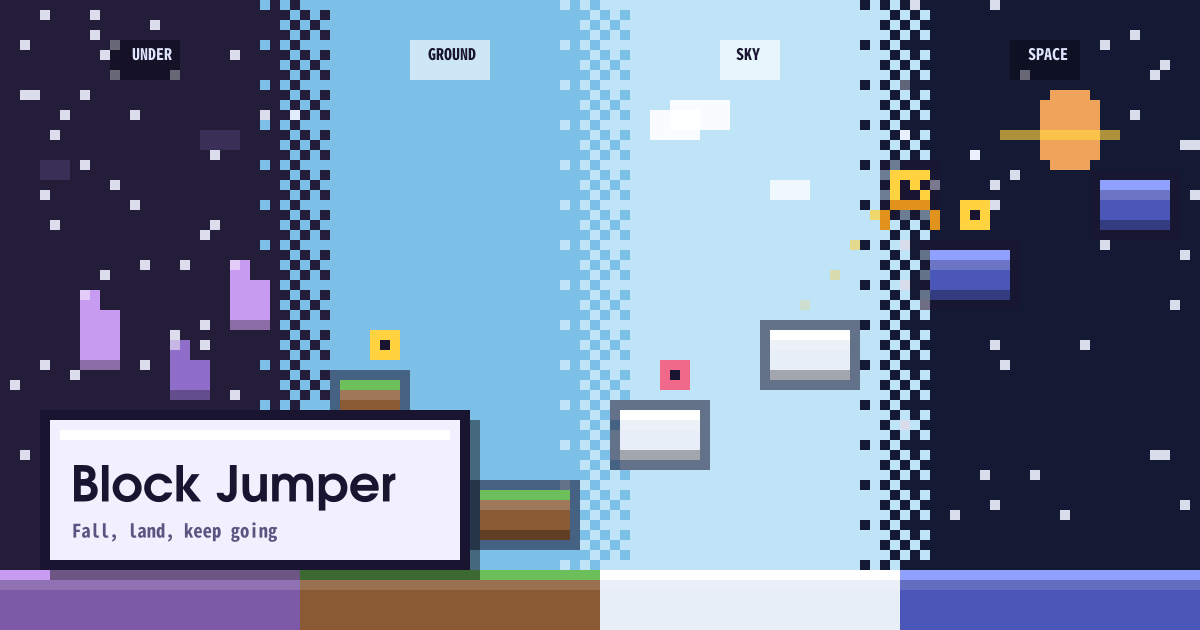
Block Jumper is a side-scrolling pixel platformer. Four themes stack as layers: underground, ground, sky, space. Lower layers feel tighter; higher ones space the blocks further apart. Play in the browser with a keyboard or the on-screen button. Nothing to install.
Controls
- Jump: space bar, or the on-screen jump button. On a phone, tap.
- One press is one jump. There is no hold-to-charge height.
- A second press in the air does not add a double jump. Wait until you are on a block again.
Hazards and falling
Spikes drop you on contact. Fake ledges vanish when you land, so even a block that looks wide deserves a beat of doubt. A fall does not always end the run: you slide into a lower theme and climb again. It is closer to “budget the fall” than “one hit, retry.”
How runs get farther
Do not jump early. Leaving from the lip of a block lands you on the nose of the next one. In space, prefer a safe landing over greed; underground, watch spike timing first. Runs improved faster when the goal was “clear one theme clean” rather than chasing score.
Commutes, tablets, and falling on purpose
A common session is one theme on a commute, then the phone locks. Nothing to install — a browser is enough, and adding it to the home screen shrinks the address bar so the jump button hides less of the landing. If it still covers the landing, drop the phone a little or find an angle that frees the thumb. A fall is not always a restart, so even a short ride can be “slide down, climb again.”
On a large tablet, spikes and fake ledges read clearly. Some people lay it landscape on a sofa and only jump.
Some players fall on purpose to learn the recovery. Choosing “this is not the moment to go up” is close to the point of the game. When a spike overlaps a recovery it can feel unfair. If you find that spot, remember the theme and a rough position and avoid that landing next run.
Is progress saved?
There is no account and no cloud save. Close the tab and the run is over. Practice is repeating a clean theme. High scores are not uploaded to a server.
Is there a double jump?
There is no double jump and no hold-to-charge height. One press is one jump. A second press in the air is ignored. Wait until you are on a block again.
How do I spot a fake ledge?
Even a block that looks wide can vanish on contact. Doubt the landing for a beat. Patterns shift a little by theme, so early runs should test ledges rather than chase score.